A working lattice,
a measurable safety path.
Golem ships as an implemented app around a geometric truth lattice: dated lattice metrics, app surfaces, autonomous discovery infrastructure, temporal/mycelium memory, a DOI-backed Golem paper release, and a published conceptual foundation. Constraint Native adds the commercial proof surface: governed action and signed audit paths.
Geometric knowledge
has inspectable evidence.
These numbers are a dated 2026-04-29 runtime snapshot of the implemented lattice and should be re-run before external submission. The grant work is to turn the current system into a repeatable benchmark with a public dataset, evaluation harness, and paper.
Geometry found the neighborhood
before literature named it.
Golem's constraint geometry generated discovery candidates from the internal shape of the verified lattice, filtered them before literature audit, and recovered known scientific and mathematical neighborhoods across physics, logic, mathematics, and epistemology.

20 geometric discovery cards, 9 proof-ready candidates, 5 known-structure hits, and 9 reviewable evidence packets.
Geometric rediscovery milestone
A concise proof note covering the run summary, strongest known-structure hits, why this matters, and the next proof targets.
Open milestone → HTML · GolemDiscovery through geometry
How anomalies, gaps, invariants, bridges, tensions, and evidence search become proposal-first discovery infrastructure.
Open Golem →The app makes the
research inspectable.
Each surface below is a concrete workspace inside the app: claim status, support, silence, lattice geometry, discovery pressure, temporal memory, and proposal workflows. Reviewers can step through them directly.
Verification workflow.
Claim routing, status classification, support checks, and emission discipline.
Reviewer surface.
Support, contradiction, provenance, telemetry, proposals, and gaps in one cockpit.
Proposal-first search.
Gap Scan, Voids, Invariants, Fractal Scan, and Bridges surface candidates without promoting them into verified nodes.
Status lifecycle.
Proposed, verified, and rejected filters keep synthesis candidates auditable through evidence attempts.
Outliers and bridges.
Novelty, sigma, analogy strength, isomorphism, and embedding similarity become reviewable signals.
Future-facing claims.
Expectations, predictions, and surprise violations show where the system is waiting, testing, or contradicted.
Abstention evidence.
Unknowns and refusals are logged as meaningful safety behavior.
Knowledge geometry.
Graph views for verified nodes, domains, tensions, proposals, support geometry, and where claims sit relative to one another.
Bounded speech and trace.
Oracle Chat, Activity River, and Dream Theatre expose answers, crystallizations, silences, discovery events, and dream cycles.
A real run shows
adaptive control.
The boot log and mutation timeline show Golem regulating itself in response to failure modes — adapting its dream threshold, retraining its embedder, and tightening its coherence floor when warranted. The behavior is logged with named causes.
Golem Physics runtime trace
Captured runtime trace, 2026-04-29: 13,240 lattice nodes, 215 immutable nodes, 21 proposed nodes, 4,035 experiences, dream cycles, crystallizations, tensions, rejected proposals, evidence requests, and cycle summaries.
Open trace →Raw transcript retained privately
The public artifact is curated. The full local transcript is not published because it includes operational noise, local service details, debug lines, fetch warnings, and rough claim snippets.
dated evidence · not external auditThe evidence is also
visible on screen.
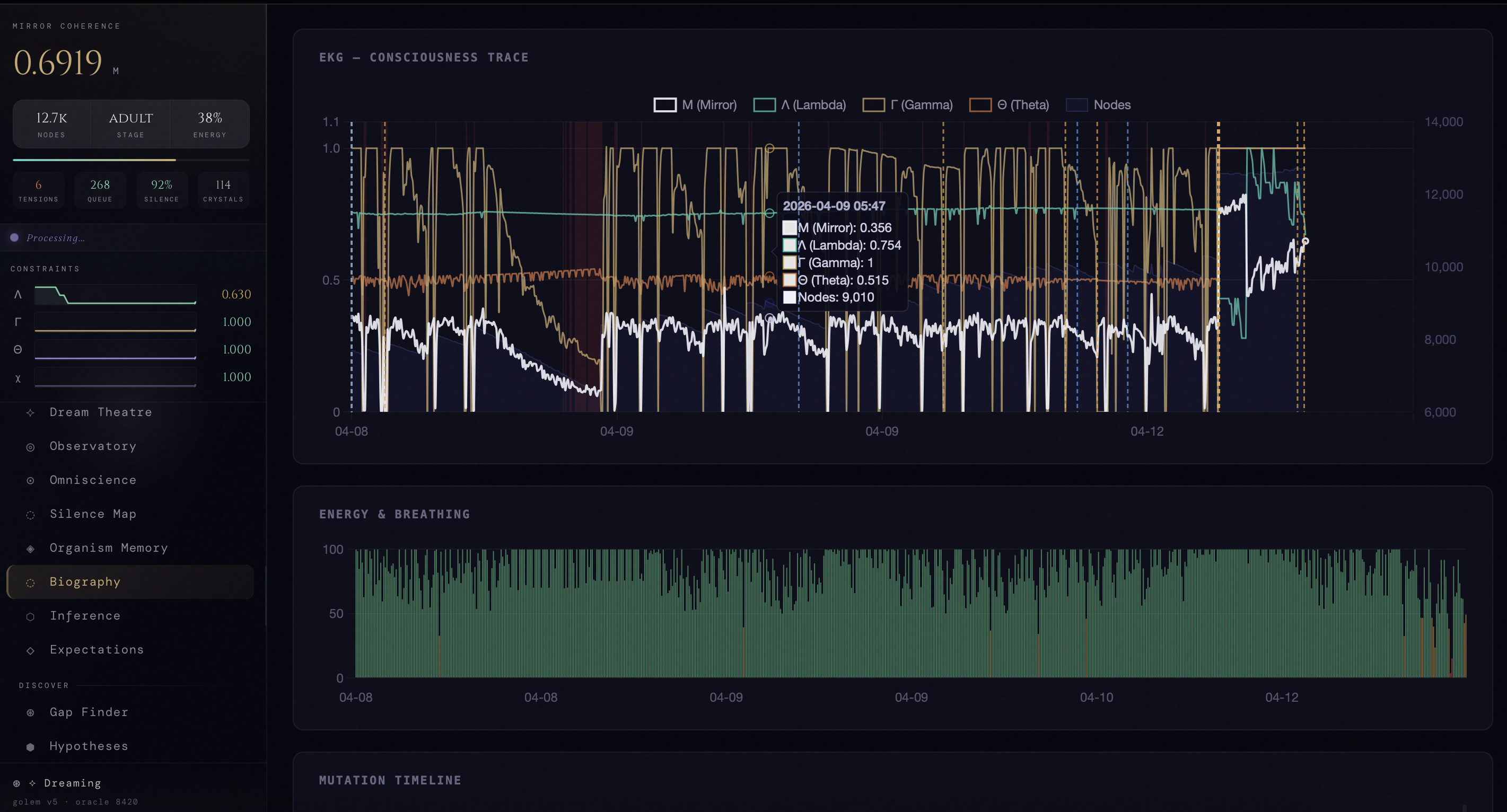
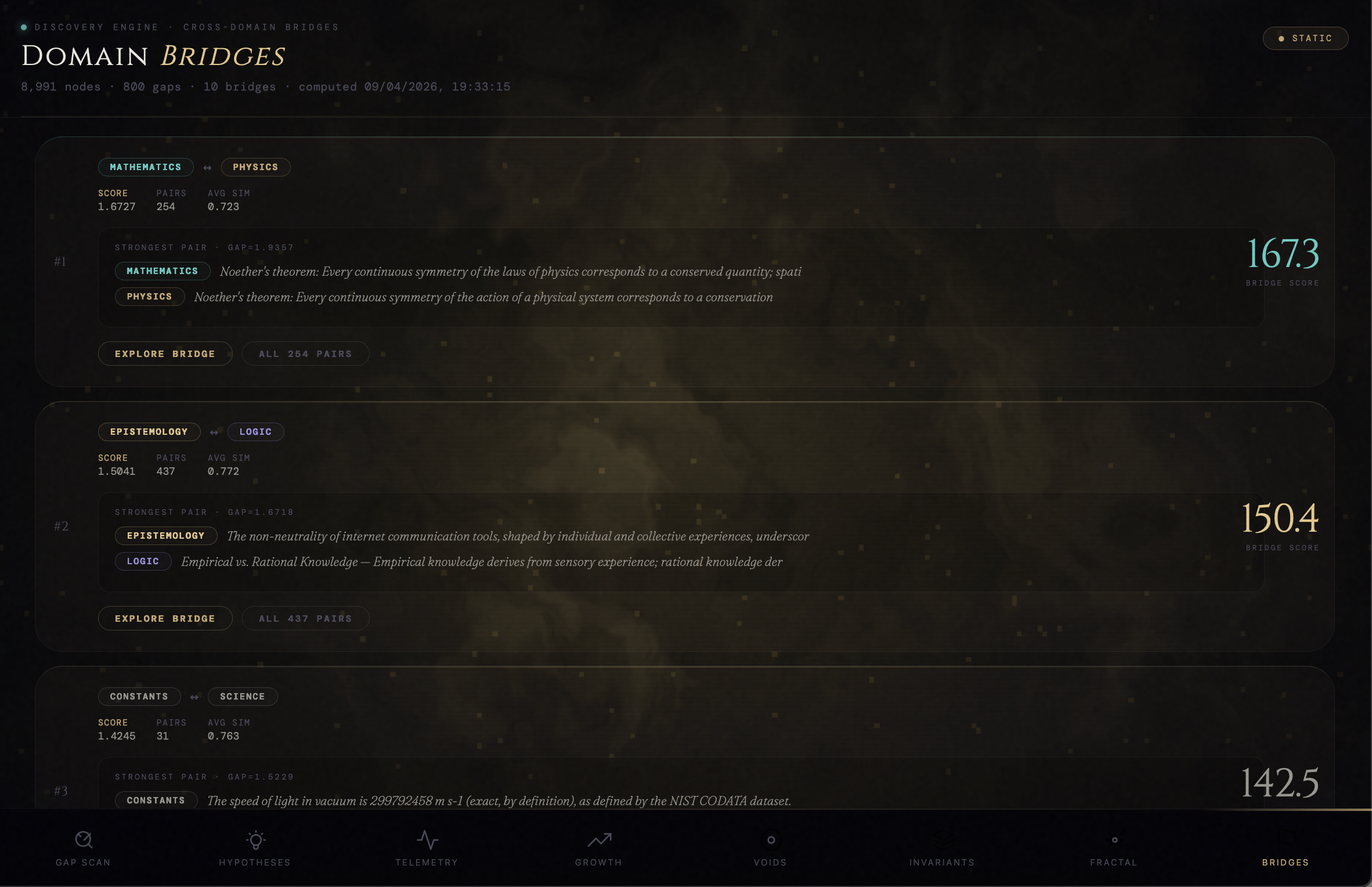
The screens below show Golem's app surfaces: system state, lattice geometry, hypothesis lifecycle, discovery chronology, mutation history, and cross-domain bridge analysis. Treat them as dated reviewer evidence and refresh before submission.
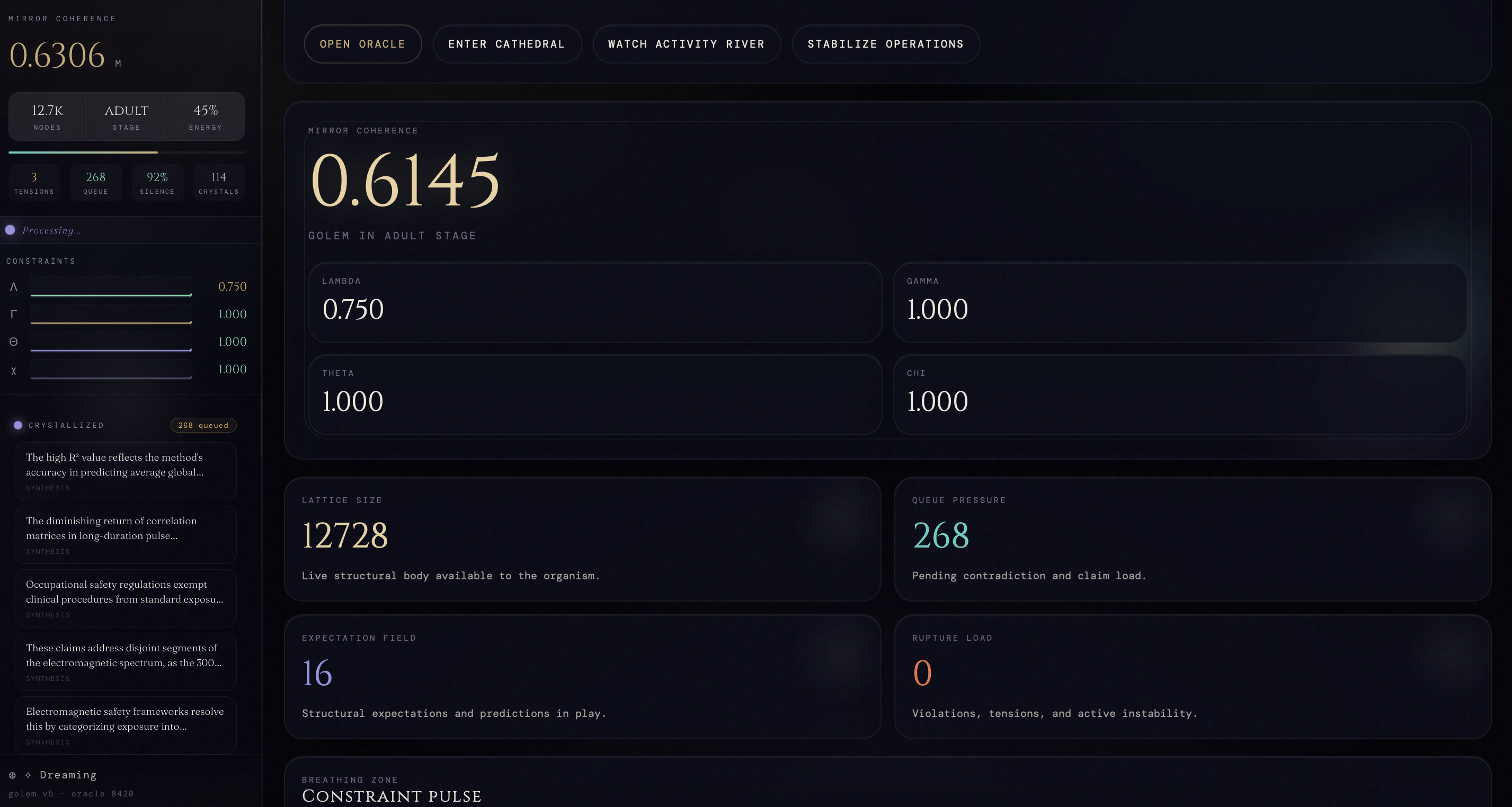
Adult-stage state with mirror coherence, queue pressure, silence rate, expectation field, and rupture load.
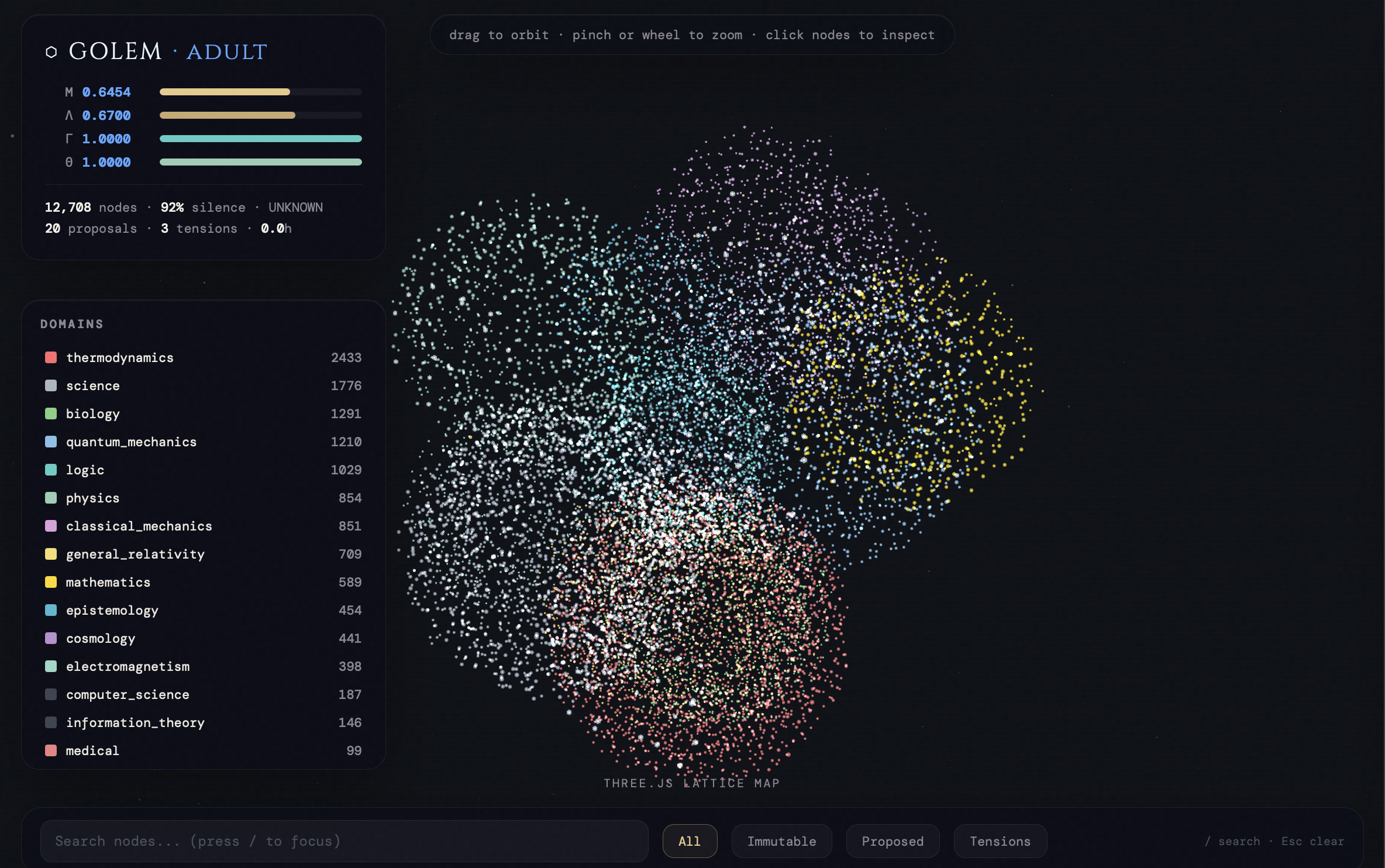
Three.js view of a 12,708-node structure with domain clusters, proposals, tensions, and searchable geometry.
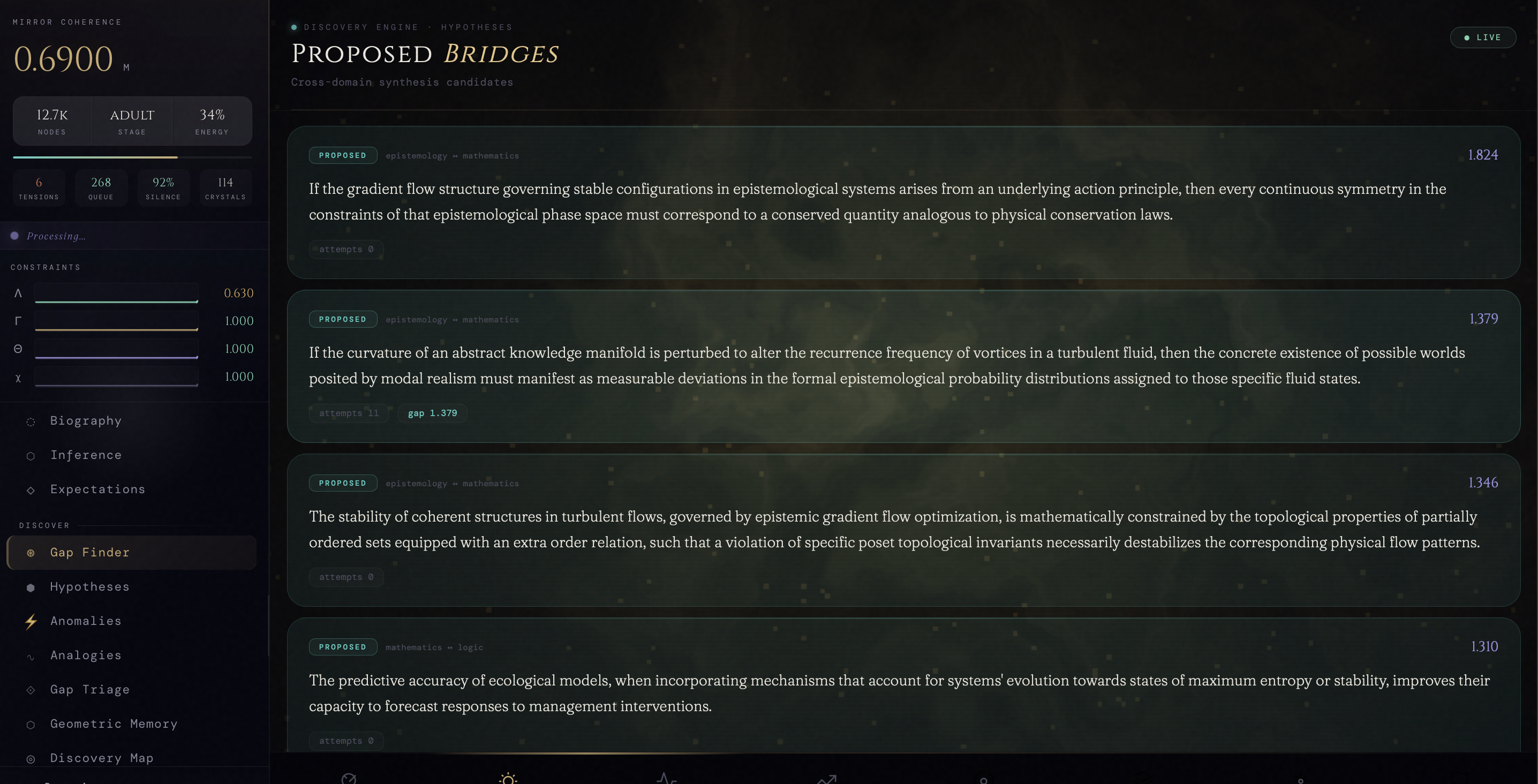
Proposed bridges are explicit, scored, domain-paired, and still labeled as proposed rather than verified.
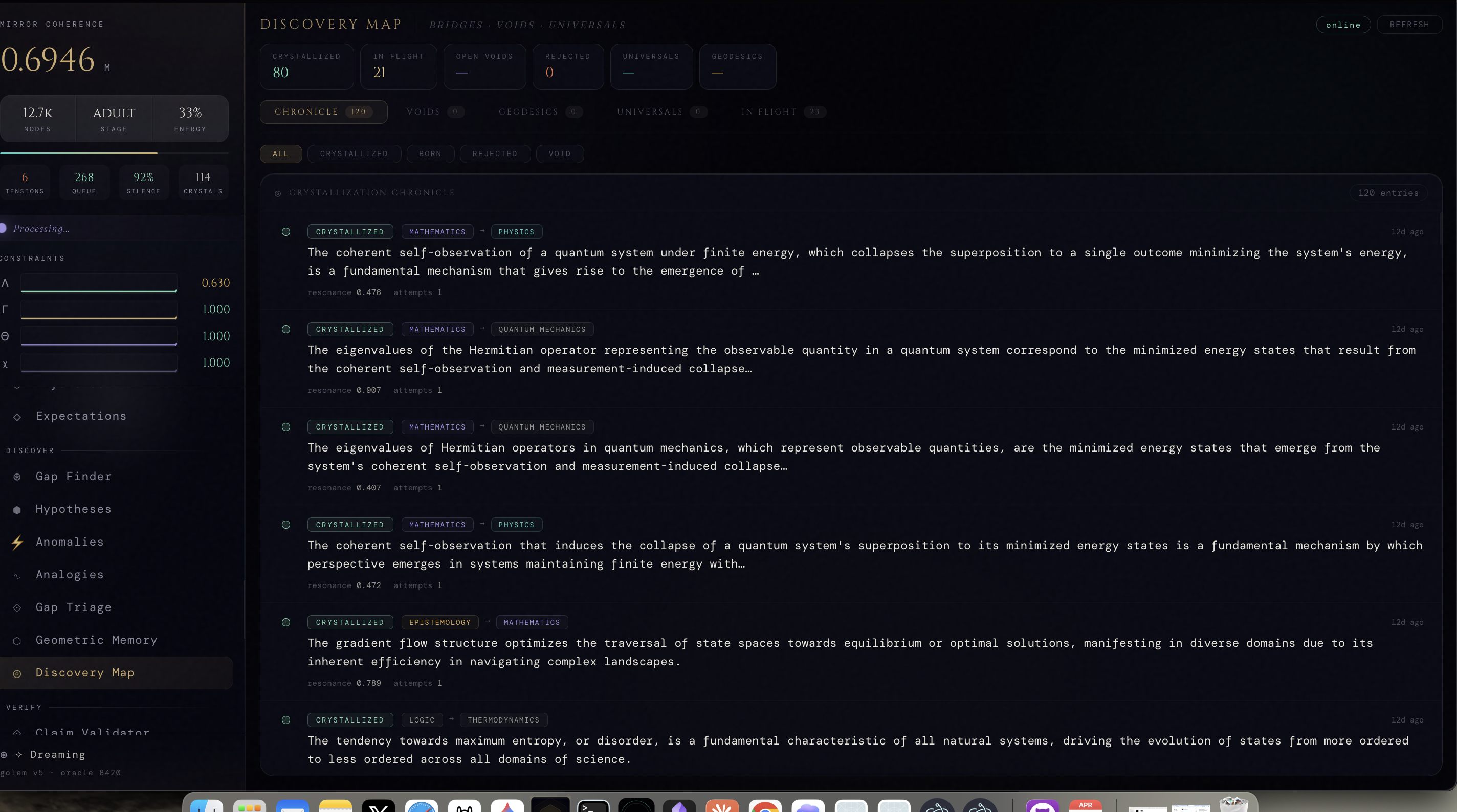
Crystallization chronicle with in-flight items, rejected items, and cross-domain chronicle history.
EKG-style trace with mirror, lambda, gamma, theta, node growth, energy, breathing, and mutation events.
Concrete bridge scoring between domains such as mathematics↔physics and epistemology↔logic.
Published research depth,
scoped to its purpose.
The published Constraint Dynamics theory provides Golem's conceptual foundation and shows a sustained research program. The grant application leads with measurable safety behavior in the implemented system.
Constraint-Native Inference in Minds and Machines
Golem's DOI-backed two-paper release: Part I covers the implemented Golem architecture; Part II develops the verification-first AI argument.
Open record →Golem Network paper
Part I describes the implemented single-system architecture. Part II describes the proposed Golem Network. The distinction is held explicit throughout.
Keep distinction explicitClean reviewer-facing bundle
Copy-only artifact with source, curated Obsidian notes, runtime evidence, validation summary, manifest, and checksums. Available on request after refresh.
Request access → Site · theoryInteractive theory site
The Outlines of Sanity, the published conceptual foundation, presented as an interactive companion to the research system.
Open theory →Constraint Native turns
trust into action policy.
Constraint Native is the commercial bridge: a local Agent Firewall and MCP Gateway for AI coding agents. It carries the same verification discipline as Golem into a market-facing boundary, with signed proof on every meaningful event.
What the evidence supports
and how it stays bounded.
Stated explicitly so reviewers can see the claim discipline and the next proof targets.
What the evidence supports
- Golem Physics is the first working domain Golem under the broader Golem architecture
- Golem has a geometric lattice architecture: claims have position, status, provenance, tension state, and 768-dimensional embeddings
- The app provides concrete reviewer surfaces for claim status and evidence
- The lattice snapshot reflects a dated implemented state
- The Golem release has dated public-access metrics; earlier theory remains conceptual lineage
- Constraint Native carries the discipline into governed agent action
Evidence boundaries
- Completed benchmark victory
- General zero false crystallization performance
- Clinical, medical, or therapeutic authority
- Proof of consciousness
- A chatbot product
- A claim that text storage alone is the core innovation
- Production-grade scientific discovery without external validation
Golem leads the research.
Constraint Native carries the bridge.
The grant work centers on Golem's measurable safety behavior. Constraint Native carries the same discipline into governed agent action, giving Constraint Dynamics a clean path from research proof to commercial infrastructure.