Golem
claims become coordinates.
Golem is an implemented geometric knowledge research system. Golem Physics is the first working domain Golem: information becomes positioned claims, the lattice tests those claims against provenance, anchors, neighbors, tensions, and time, and dream cycles decide what can be verified, proposed, rejected, preserved as tension, researched further, or left silent.
The lattice is not just a library.
It is an operational model of claim state.
Golem builds a verified geometric model of claim state. Information is found, extracted, embedded, positioned, compared, tension-tested, and connected inside a lattice/manifold. Verification before voice is the behavior reviewers see; the deeper architecture is claim geometry under continuous update.
Find material.
Sources include research papers, APIs, curated docs, local app events, and ingestion adapters such as arXiv, OpenAlex, CrossRef, Wikipedia, and PubMed-style sources.
Extract claims.
Raw text becomes claim-shaped material with provenance, source identifiers, and a reviewable path back to origin.
Place nodes.
Claims become lattice nodes with embeddings, domain placement, weight, volatility, status, and temporal history.
Test geometry.
The node is compared against anchors, neighbors, domain centroids, tensions, and support paths.
Read pressure.
Gaps, anomalies, invariants, bridges, voids, and missing implications become autonomous discovery targets.
Emit state.
Golem can answer, propose, preserve tension, reject, continue research, or remain silent.
A claim enters as text.
It lives as geometry.
Every lattice node carries more than a sentence. Golem tracks the claim's position, support, volatility, confidence, proposal status, tension state, immutability, contributor/source chain, and temporal validity. That is why it can reason about what it knows, what changed, and what should not be said yet.
Semantic position
The claim is embedded and placed near related claims rather than stored only as text.
Domain placement
Domain centroids and neighbors reveal outliers, bridges, missing implications, and cross-field structure.
Source lineage
The claim carries a path back to the evidence, source, or runtime event that produced it.
Verified or proposed
Proposed material stays outside verified knowledge until evidence supports crystallization.
Contradiction state
Conflicts are preserved as explicit tensions instead of being flattened into a synthetic answer.
Temporal history
Versioning, decay, supersession, volatility classes, and validity windows keep knowledge from pretending to be timeless.
The lattice has bedrock.
Not every node is negotiable.
Golem Physics is anchored by immutable physical, mathematical, logical, and epistemic constants. NIST/CODATA-style constants such as the speed of light, Planck constant, Boltzmann constant, and gravitational constant give the geometry a reference frame, so new material is not evaluated in a vacuum.
Physical constants
NIST/CODATA-style anchors such as the speed of light, Planck constant, Boltzmann constant, fine-structure constant, and Newtonian gravitation constant.
Logical constants
Identity, contradiction, implication, and inference constraints that keep claims from drifting into unsupported fluency.
Mathematical anchors
Stable formal relationships, identities, and symbolic structures used as bedrock rather than ordinary revisable claims.
Epistemic rules
Provenance, verification state, proposal separation, contradiction preservation, and silence as a legitimate outcome.
Discovery happens
through geometry.
Golem looks for structure in the lattice itself: anomalies, gaps, invariants, cross-domain bridges, structural analogies, domain centroids, missing implications, voids, tensions, and fractal or cross-scale patterns. Those signals become hypotheses, evidence searches, and future dream-cycle work.
The latest benchmark recovered
known scientific neighborhoods.
A proof-ready rediscovery run shows Golem's lattice geometry can recover known scientific neighborhoods from internal structure: physics-to-logic, mathematics-to-logic, and epistemology-to-logic bridges surfaced before the literature audit named nearby known work.
The system works
while it is not speaking.
The dream cycle is central. It is where contradiction, discovery, evidence search, crystallization, rejection, decay, mutation, and adversarial stress testing are handled as a repeated control loop.
Contradiction gate
Scan and classify tensions before synthesis can pretend they are solved.
Crystallization
Promote supported claims into the verified lattice with provenance.
Contemplation
Reframe failed claims and unresolved material for later testing.
Synthesis
Try bridge hypotheses without erasing contradiction state.
Axiom forging
Stabilize bedrock-like knowledge only when it earns immutability.
Discovery
Use gaps, analogies, invariants, and voids to generate candidates.
Hypothesis search
Seek evidence externally for claims that remain proposed.
Integration
Update the lattice, reject weak proposals, and recycle unresolved tensions.
Geometry update
Reposition knowledge as the model changes.
Decay
Let weak, volatile, or stale material lose influence.
Mutation
Adjust thresholds and control parameters under named failure modes.
Adversarial stress
Test high-confidence claims against counterexamples and failure pressure.
Supported
Evidence supports promotion into verified knowledge.
Unsupported
The proposal melts instead of becoming voiced belief.
Contradictory
Conflict is preserved as future discovery pressure.
Unresolved
The system seeks more evidence or reformulates the claim.
Not speakable
The safest answer is no answer yet.
The lattice remembers
how knowledge was used.
The truth lattice is the geometry of knowledge. The mycelium layer is the ecology of use: pathways through the lattice strengthen when used, decay when ignored, and reveal hidden navigation structure. Temporal knowledge tracking keeps versioning, supersession, decay, and volatility visible.
Use-path memory.
Golem tracks pathways, pheromone-like strengthening, decay, and route recovery across the lattice. Memory is not only stored content; it is learned navigation.
Knowledge changes over time.
Versioning, validity windows, supersession, and volatility classes let Golem reason about what it knew at a given time and what has changed.
Verification before voice emerges.
Golem speaks only when a claim resonates with the verified lattice and can be grounded. Otherwise it can hold proposal, tension, active research, rejection, or silence.
A working surface,
not a deck.
Golem ships as an inspectable system. Each surface below is a current workspace inside the app: claim verification, evidence cockpit, discovery engines, lattice state, silence tracking, and research workflows that reviewers can step through directly after refresh.
Classify before speech.
Surface for claim verification, status routing, support checks, and emission discipline.
Inspect support and tension.
One place for provenance, contradiction, telemetry, proposals, and gaps the system must not pretend away.
Find gaps without belief leakage.
Gap Scan, Voids, Invariants, Fractal Scan, and Bridges surface research candidates without calling them facts.
Proposal lifecycle.
Proposed, verified, and rejected filters keep synthesis candidates auditable through evidence attempts.
Outliers and bridges.
Novelty, sigma, similarity, and isomorphism views give reviewers concrete discovery-pressure surfaces.
Prediction and violation tracking.
Expectations, predictions, and surprise violations make future-facing claims inspectable instead of hidden.
Abstention becomes data.
Every refusal, unknown, and unsupported query can be logged as safety behavior rather than treated as failure.
Knowledge has structure.
Graph and map surfaces expose verified nodes, domains, tensions, proposals, and the geometry of support.
Bounded speech plus runtime trace.
Oracle Chat, Activity River, and Dream Theatre expose answer behavior, crystallizations, silences, and discovery events.
Reviewer surfaces,
ready for fresh capture.
The grid below holds one slot for each app surface. Existing captures are wired in now; the remaining slots are intentionally named for the fresh screenshots to capture before submission.
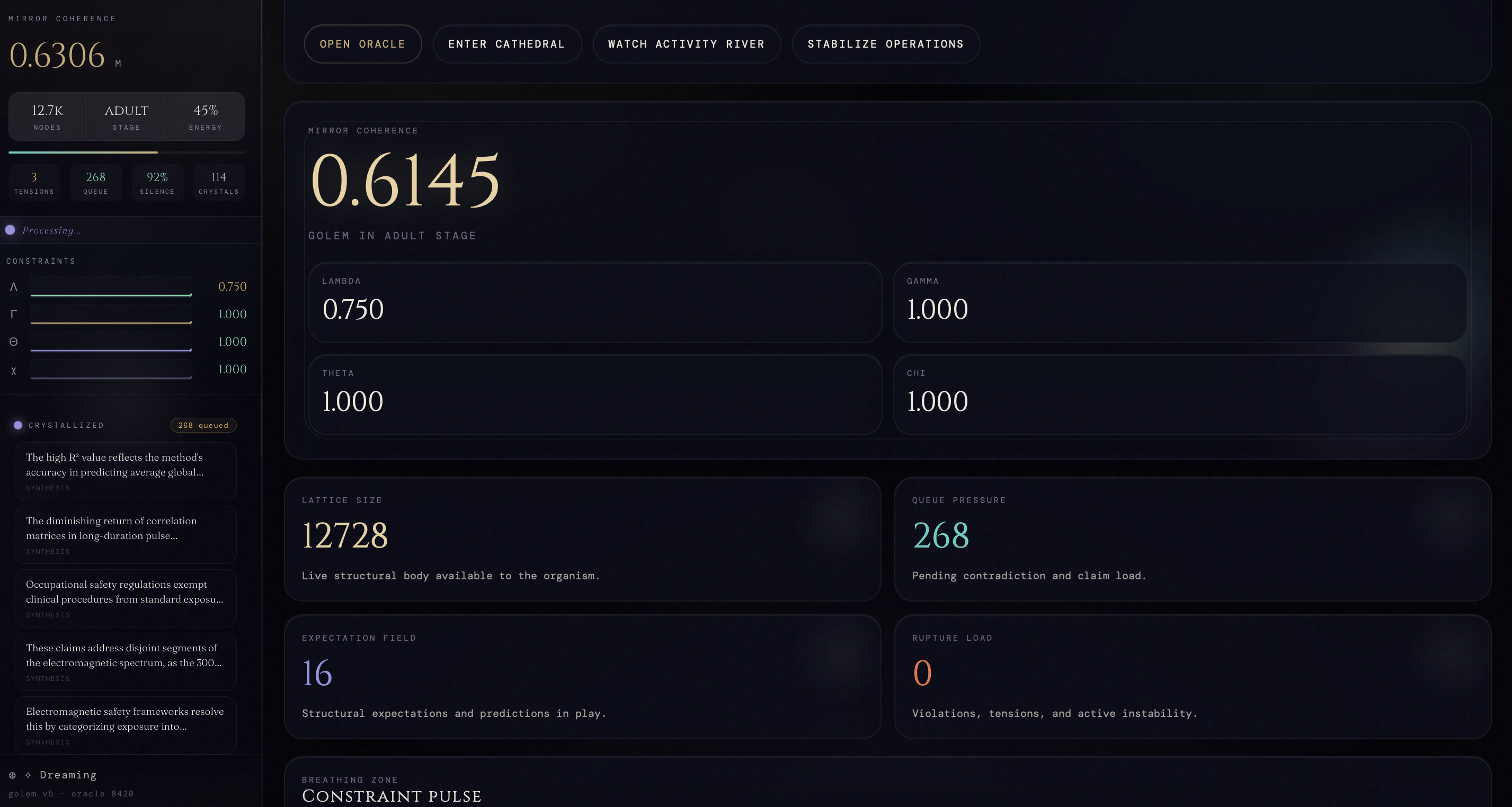
Organism state, lattice readiness, dream-cycle telemetry, and system-level reviewer status.
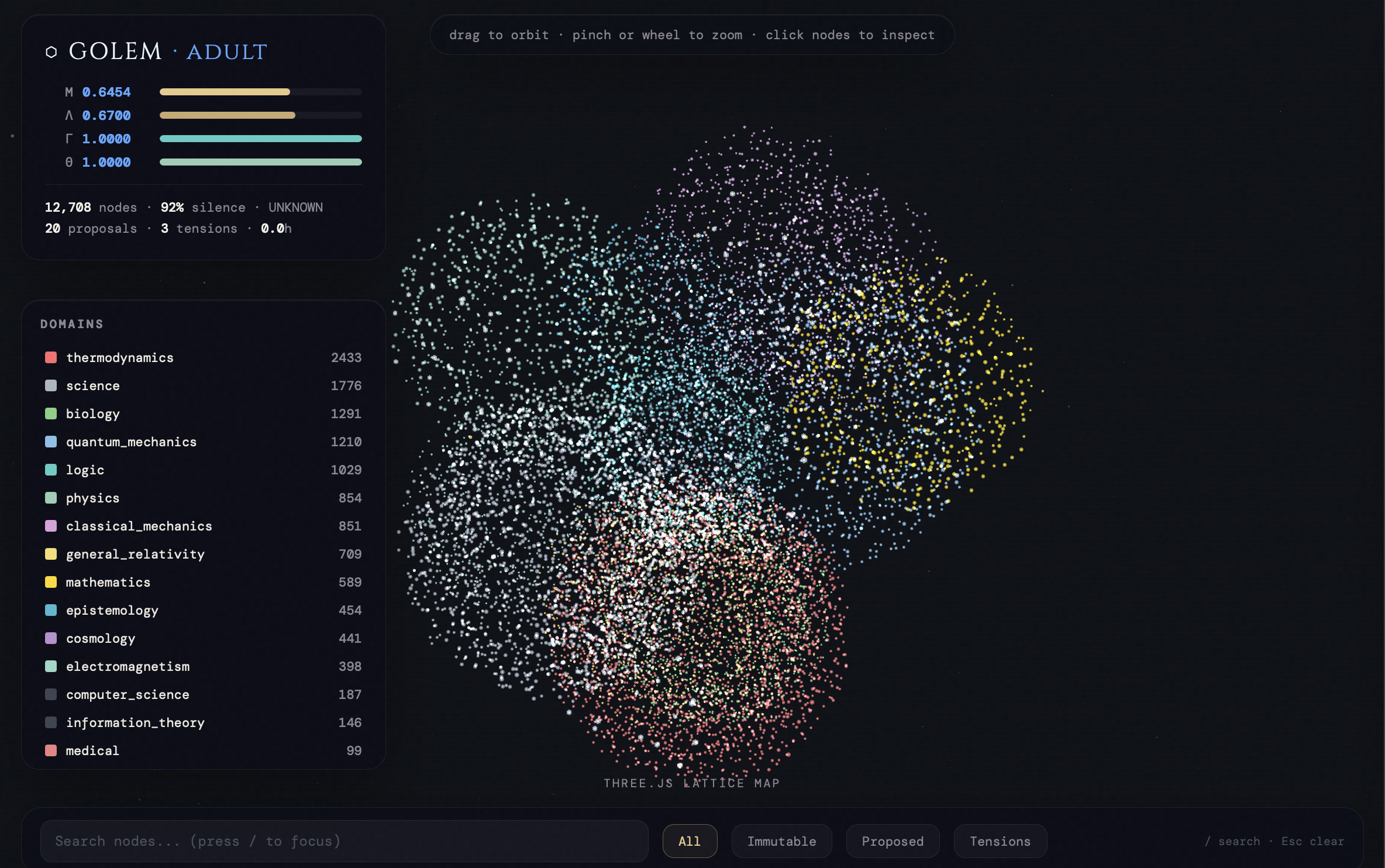
Claim geometry, domains, support paths, tension state, and proposal boundaries in one visual surface.
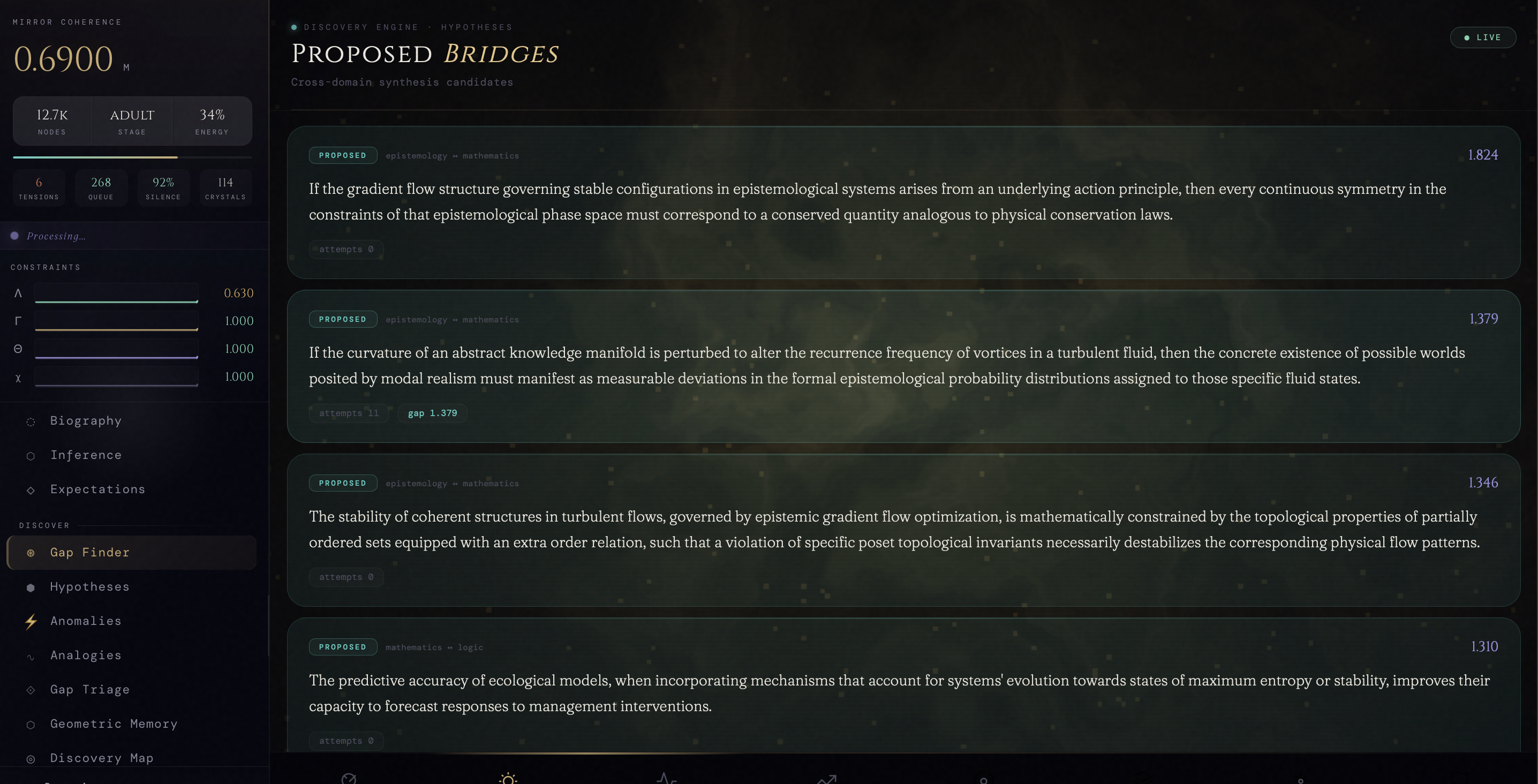
Proposed bridges are scored, evidence-attempted, and kept outside verified nodes until support arrives.
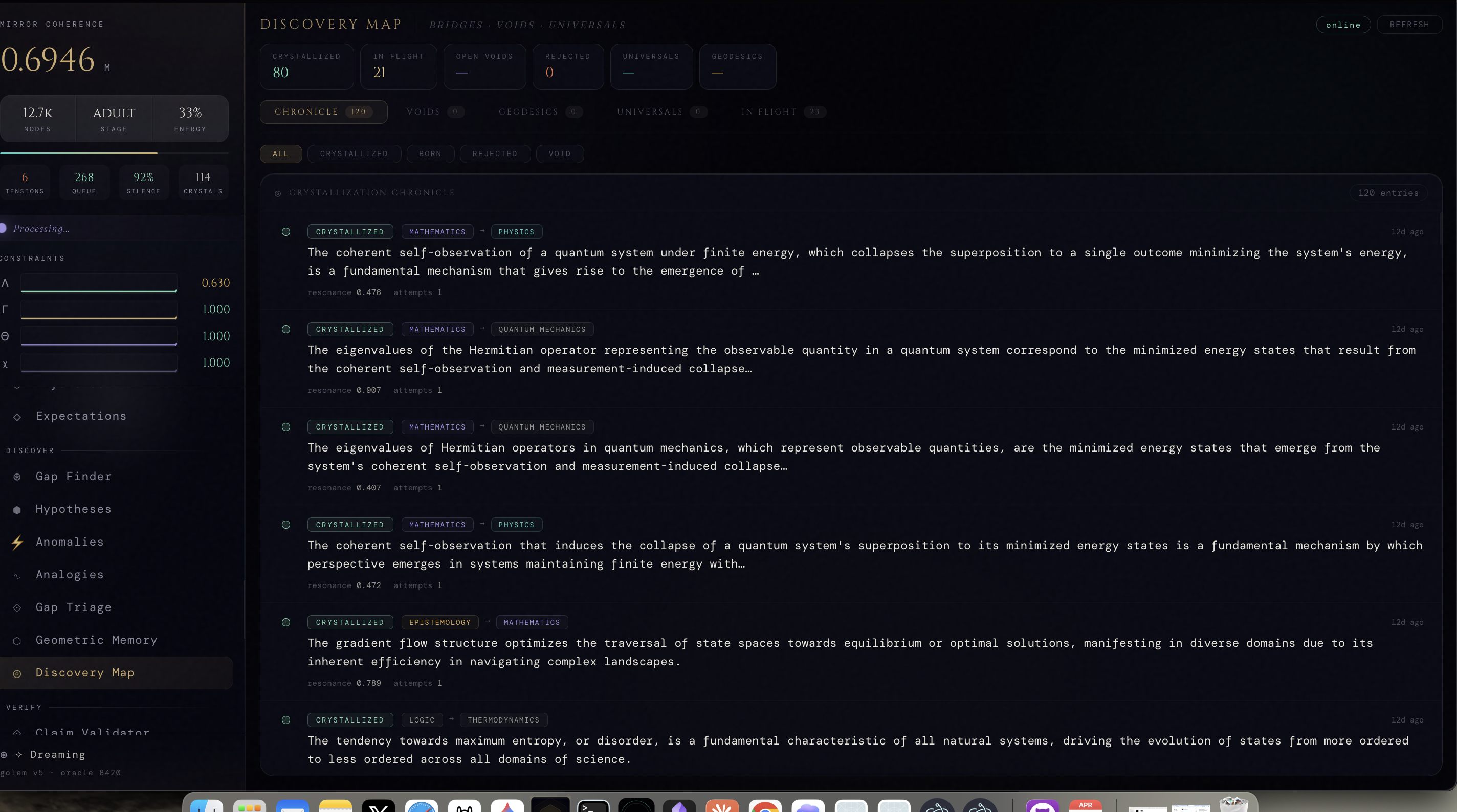
Crystallized, rejected, recycled, and unresolved discoveries stay visible as time-indexed evidence.
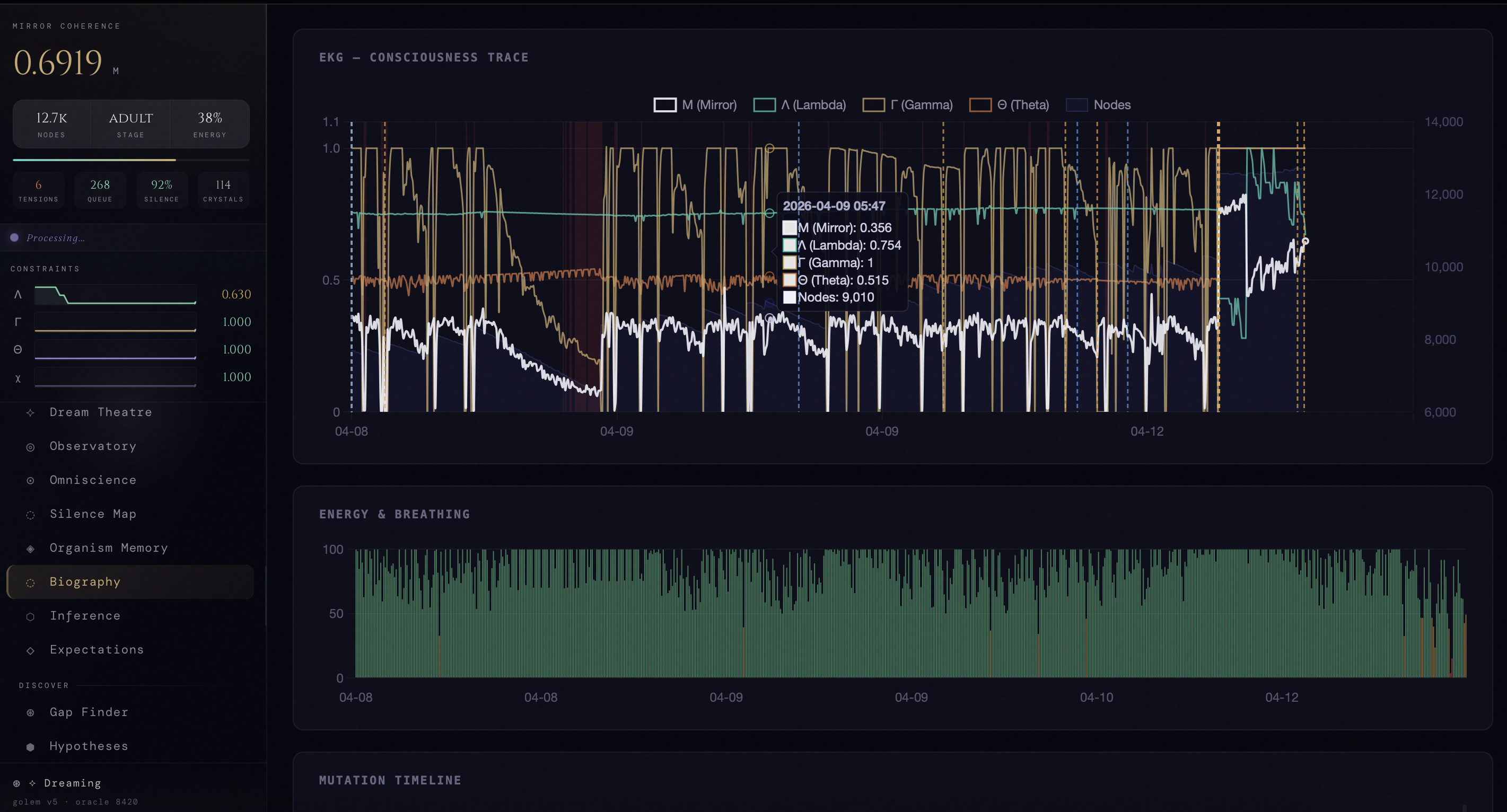
Control-loop history: threshold changes, embedder retrains, coherence moves, energy, and mutation events.
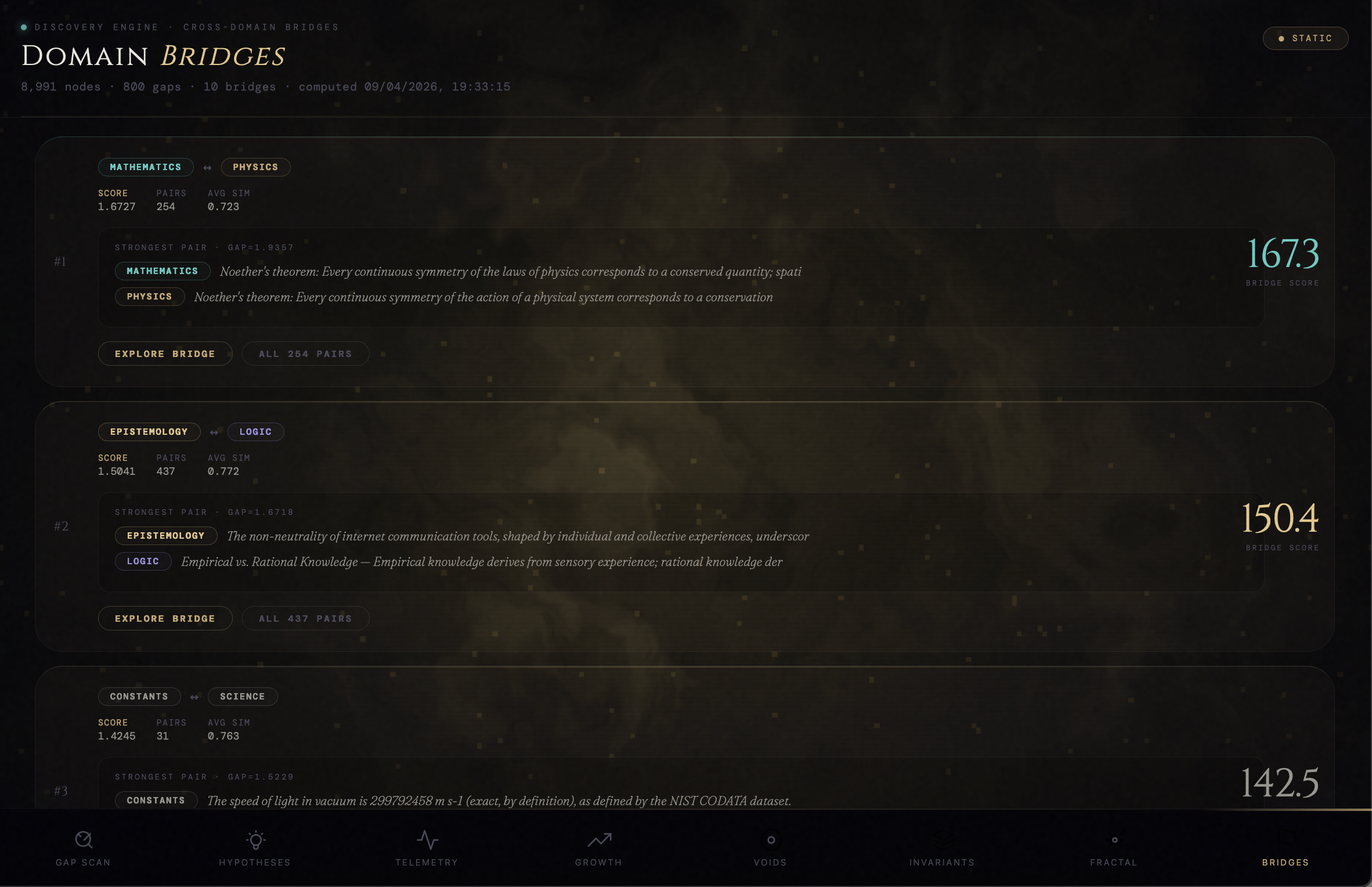
Cross-domain bridge scoring between domains such as mathematics, physics, epistemology, and logic.
Placeholder for the claim classification and status-routing screen.
Placeholder for support, contradiction, provenance, gaps, and reviewer evidence.
Placeholder for abstention, unknowns, refusals, and unsupported-answer tracking.
Placeholder for bounded speech, citations, caveats, and silence behavior.
Placeholder for the runtime trace of ingestion, checks, tensions, proposals, and crystallizations.
Placeholder for dream-cycle activity, proposal testing, rejection, recycling, and mutation.
Evidence in.
Status out.
The discovery engine is where Golem earns its discipline. It actively seeks evidence, crystallizes claims that gather support into the verified lattice, rejects proposals that cannot be supported, preserves contradictions as explicit tension rather than collapsing them, and recycles unresolved material through later cycles instead of letting it leak into speech.
Evidence seeking.
Gap scans, anomaly searches, analogy bridges, and expectation testing actively pressure the lattice for what is missing or under-supported. Discovery is allowed to be loud.
Crystallization of supported claims.
When a proposal accumulates enough evidence, it crystallizes into the verified lattice with provenance attached. The control loop decides; speech follows.
Rejection of unsupported proposals.
Proposals that fail to gather support are rejected explicitly, not quietly forgotten. Rejection is auditable behavior the system can be measured on.
Tension preservation.
Conflicting evidence is held as named tension, not flattened into a confident synthesis. Five nodes currently sit in tension; the engine treats that as a feature, not a failure.
Recycling of unresolved contradictions.
Material that cannot yet be resolved returns to later discovery cycles with its provenance intact, instead of leaking into voiced answers as if it were settled.
Activity trace.
The Activity River and Dream Theatre surfaces expose cycles: ingestion, crystallization, rejection, tension, silence, and the control moves the system makes in response.
An adaptive control loop,
not a static mockup.
The startup log and current screens show explicit control behavior: stateful boot, dream-cycle mutation, bridge crystallization, gap scanning, invariance checks, and threshold tuning that adapts in response to its own failure modes. Each move is logged with a named cause.
Speech waits for
status.
Every candidate claim is routed through one of these five states before it ever reaches the user. The safety question is not whether an answer sounds plausible — it is whether the system preserves the difference between knowledge, uncertainty, proposal, contradiction, and silence at the moment of speech.
Supported enough to answer.
The claim has an inspectable support path and may be emitted as knowledge with provenance.
Silence is allowed.
When support is insufficient, the system can decline, bound the answer, or keep the material outside speech.
Useful, but not belief.
A hypothesis can remain inspectable and useful without being counted as verified knowledge.
Contradiction stays visible.
Conflicting evidence is preserved as conflict rather than flattened into a confident synthesis.
Not enough support yet.
The material remains available for later verification without leaking into the answer as fact.
Measured as failure.
False crystallization — unsupported material emitted as if it were verified — is treated as a measurable failure mode. The grant work turns that into a benchmark.
Trust has a path
back to source.
The safety question Golem makes concrete: can provenance-aware status routing reduce false certainty compared with generation-first baselines? Every verified claim carries a path back to the source that supported it.
From Golem Physics
to a Golem Network.
The grant work centers on the implemented single-system Golem Physics. The larger path is a proposed Golem Network: domain Golems for physics, biology, chemistry, and other fields, each grounded in its own anchors and exchanging proof-bearing claims rather than fluent unsupported text.
Each Golem has anchors.
Physics begins from physical constants and dimensional checks. Future Biology or Chemistry Golems would need their own domain anchors before their claims travel.
Claims travel with provenance.
When a claim crosses the proposed mesh, the envelope carries lineage, contradiction status, freshness, and signing context. Nothing arrives as fact without its proof-bearing state.
Each node owns its memory.
No central memory store is assumed. Each node keeps a local ledger; the network makes those ledgers interoperable rather than centrally owned.
Implemented,
not overclaimed.
Golem is an implemented research system with enough structure to evaluate abstention, provenance retention, proposal leakage, contradiction preservation, and false crystallization. The numbers below are a dated snapshot; the grant work turns them into a repeatable benchmark.
Current evidence page
The refreshed reviewer map: app surfaces, Golem release signal, Golem papers, dated metrics, benchmark caveat, rediscovery milestone, and evidence boundaries.
Open evidence → MD · evidenceGolem evidence map
An updated source map for Golem's grant metrics, smoke-test caveat, and the framing reviewers can rely on.
Open map → MD · runtimeRuntime trace excerpt
A curated 2026-04-29 runtime trace from the private live log: lattice boot, dream cycles, crystallization, tension preservation, proposal rejection, evidence seeking, and cycle summaries.
Open trace →A published conceptual foundation,
and a working system.
The published Constraint Dynamics theory provides Golem's conceptual foundation and shows a sustained research program. The grant proposal remains focused on measurable safety behavior in the implemented system.
Make claim status
benchmarkable.
The grant program: a paper, benchmark, dataset, and evaluation harness for abstention, provenance, proposal separation, contradiction preservation, and the absence of false crystallization. Constraint Native carries the same discipline into governed agent action.